

Can a Pipe Flange Welding Machine be used for underwater welding of pipe flanges?
As a supplier of Pipe Flange Welding Machines, I often encounter various inquiries from customers regarding the capabilities and applications of our machines. One frequent question that arises is whether a pipe flange welding machine can be used for underwater welding of pipe flanges. In this blog post, I aim to delve into this topic, exploring the technical aspects, challenges, and potential solutions.
Technical Considerations
Pipe flange welding machines are typically designed for on - land welding operations. They are engineered to provide precise control over the welding process, ensuring high - quality welds in a stable environment. The two main types of machines we offer, the CNC Flange Pipe Welding Machine and the Tig Flange Pipe Welding Machine, excel in their respective welding techniques but are primarily intended for above - water use.
Underwater welding, on the other hand, presents a completely different set of challenges. The most obvious difference is the presence of water, which has a significant impact on the welding process. Water can cause rapid cooling of the weld, leading to increased hardness and potential cracking. Additionally, the water pressure at depth can affect the stability of the arc and the flow of the welding material.
The welding machines we supply are equipped with specific features and components that are optimized for dry conditions. For example, electrical insulation is designed to prevent short - circuits in normal atmospheric conditions, not in a wet environment. The control systems of these machines rely on accurate feedback mechanisms that can be disrupted by the presence of water.
Challenges of Using on - Land Welding Machines Underwater
- Corrosion and Water Ingress: Water is a highly corrosive medium. The metal components of a pipe flange welding machine can corrode rapidly when submerged, leading to mechanical failures and reduced lifespan. Moreover, water ingress into sensitive electrical and electronic components can cause short - circuits and damage the control systems.
- Arc Stability: Maintaining a stable arc is crucial for high - quality welding. In an underwater environment, the presence of water vapor and the cooling effect of the water can make it extremely difficult to sustain a stable arc. The welding arc can be blown out by the movement of water or the release of hydrogen gas, which is generated when water is decomposed by the arc.
- Material Flow and Weld Quality: The flow of the welding filler material is affected by the water pressure and the cooling rate. In underwater welding, it is challenging to ensure that the filler material spreads evenly and fuses properly with the base metal. This can result in incomplete fusion, porosity, and other weld defects.
Potential Solutions
While using a standard pipe flange welding machine directly for underwater welding is not feasible, there are some potential solutions to adapt the technology.
One approach is to develop a waterproof enclosure for the welding machine. This enclosure would need to provide a dry and stable environment for the machine components while allowing the welding torch to extend out into the water. The enclosure would need to be pressure - resistant to withstand the water pressure at different depths.
Another solution is to modify the welding process itself. For example, using a special welding electrode or filler material that is more suitable for underwater conditions. Some electrodes are designed to generate a gas shield around the arc, which helps to protect it from the water and maintain stability.
Case Studies and Industry Experience
In the oil and gas industry, underwater welding of pipe flanges is a common requirement for offshore installations. In most cases, specialized underwater welding equipment is used. These machines are designed from the ground up to operate in a wet environment, with features such as waterproof enclosures, corrosion - resistant materials, and advanced arc - control systems.
However, there have been some attempts to adapt on - land welding technology for underwater use. Some companies have experimented with using modified pipe flange welding machines in shallow - water applications. These modifications included adding waterproof covers and using special welding techniques to overcome the challenges of the underwater environment. While these experiments have shown some promise, they are still far from being a mainstream solution.
Conclusion
In conclusion, while a standard pipe flange welding machine is not suitable for direct use in underwater welding of pipe flanges, there is potential for adaptation and innovation in this area. The challenges of corrosion, arc stability, and weld quality need to be addressed through the development of specialized enclosures, modified welding processes, and the use of appropriate materials.
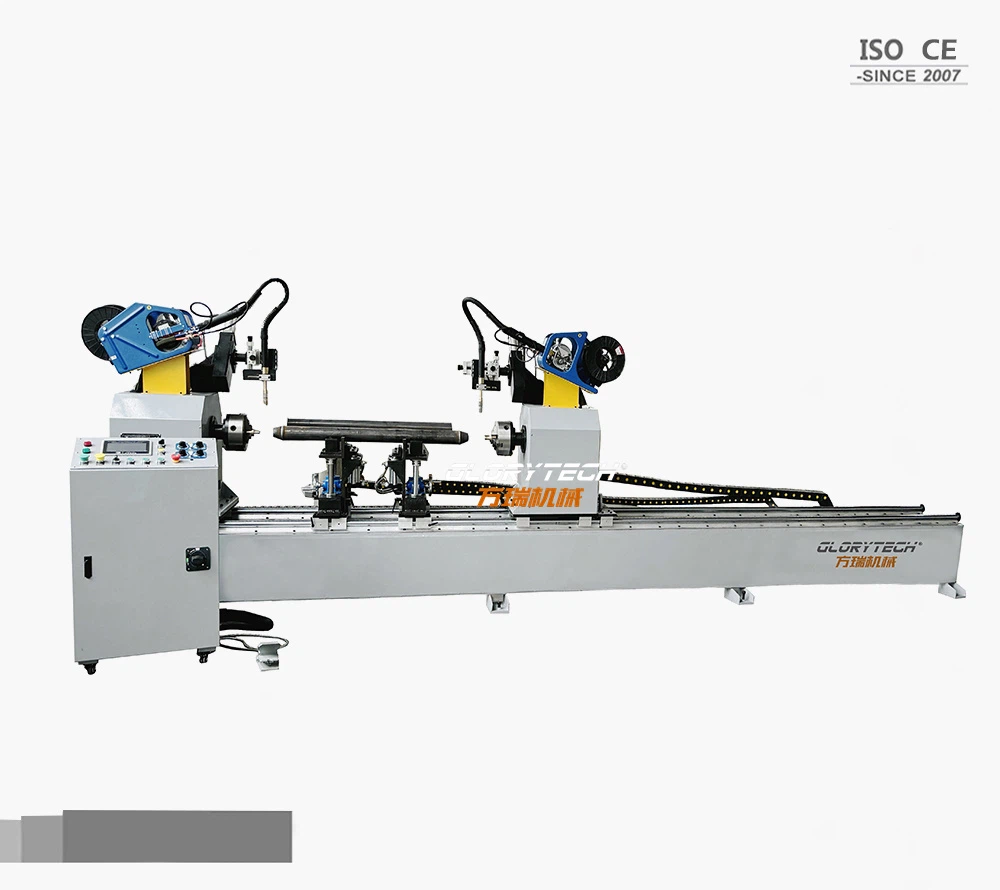

If you are in need of high - quality pipe flange welding machines for on - land applications, our Pipe Flange Welding Machines offer reliable performance and precision. We also welcome discussions on potential customizations and adaptations for unique welding requirements. If you are interested in learning more about our products or have any questions regarding welding applications, please feel free to contact us for further details and to start a procurement discussion.
References
- AWS D3.6M:2010, Standard for Underwater Welding - Qualification of Welders and Welding Procedures
- ASME Boiler and Pressure Vessel Code, Section IX, Welding and Brazing Qualifications